NSA Warrantless Mass Surveillance Dragnet
United States
2001, Aug 01
Six weeks after 9/11, President George W. Bush secretly authorized the NSA to bypass the FISA court and conduct bulk collection of American telephone metadata and, in many cases, content. With full cooperation from AT&T, Verizon, and other telecom giants, the NSA installed secret splitters at major internet backbone facilities (e.g., AT&T’s Room 641A in San Francisco) that copied every email, web browse, and phone call flowing through those pipes—domestic and international alike—directly to NSA servers. This continued for years in complete secrecy.
After the New York Times exposed the program in late 2005, Congress retroactively legalized much of it through the 2008 FISA Amendments Act and Section 215 of the Patriot Act. The Snowden disclosures in 2013 proved the program had grown far beyond even what was admitted:
Daily collection of nearly every American’s phone records (who called whom, when, duration, location)
“Upstream” tapping of fiber-optic cables capturing content of millions of domestic communications
PRISM direct access to Google, Facebook, Microsoft, Apple, etc.
All without individualized warrants, in direct violation of the Fourth Amendment.
Negative effects:
- Destroyed the constitutional requirement for probable-cause warrants, effectively nullifying the Fourth Amendment for digital communications.
- Turned the United States into the most advanced surveillance state in world history—against its own people.
- Forced telecom companies to become arms of the intelligence community and granted them retroactive immunity, ending private accountability.
- Chilled free speech, free association (First Amendment), and investigative journalism; reporters and sources now assume total surveillance.
- Radically eroded public trust in government: polls after Snowden showed majority of Americans believed the government was spying on them (they were right).
- Exported the architecture and justification for global mass surveillance, giving authoritarian regimes the playbook they still use today.
Sources
Electronic Frontier Foundation
https://www.eff.org/nsa-spying
Books
Confessions of an Economic Hit Man
by John Perkins
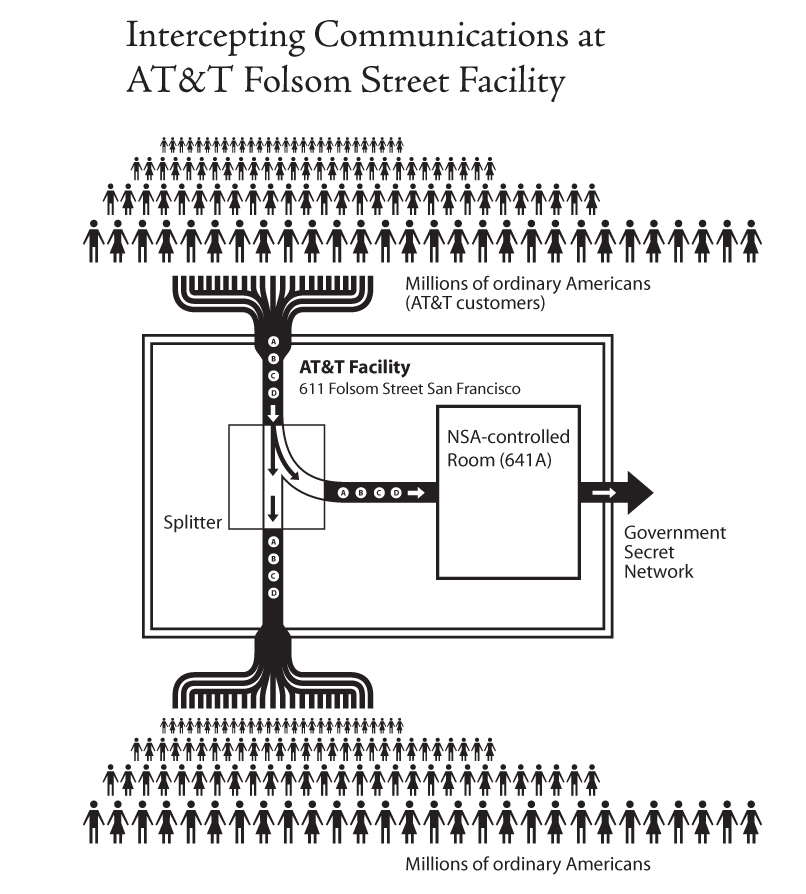
AT&T Interecepting Communications